
The Greek philosopher Heraclitus once said you could not step into the same river twice. The water is always moving, always different, even when the riverbed looks the same.
Today’s workplaces work the same way. Leases shrink. Footprints fluctuate. Teams relocate, consolidate, and grow again. Yesterday’s 30,000-square-foot workplace can become tomorrow’s 12,000. The space changes even when the address doesn’t.
Every one of those changes eventually reaches the same moment: someone has to decide what happens to the furniture and equipment left behind.
When a lease is coming to an end, do you know what condition the space needs to be left in? What has to stay, what needs to be restored, and where the rest of it is going? And maybe more importantly, who actually owns that process, your internal Facilities or Real Estate team, your Workplace group, or an outsourced provider?
Too often, nobody has a clear answer until the final week of the project. A truck gets called, a dumpster gets ordered, and whatever doesn’t fit the new plan ends up in a landfill. It works, in the sense that the space gets cleared, but it leaves real value, and real opportunity, on the table. Sustainability in the modern workplace isn’t just about leasing less space; it’s about wasting less of what you already own while maintaining workplace standards.
Sustainable decommissioning is a different approach. Instead of treating end-of-life furniture as a problem to remove, it treats it as an asset to manage, one with financial worth, environmental impact, and community value still built in.
Why This Deserves a Real Plan
Furniture decommissioning is often the least planned part of a project and the part with the most consequences. Rushed timelines tend to default to disposal, resale opportunities close, and there’s no data left to report once the dumpster is gone.
That last point matters more than it used to. Furniture is increasingly part of how organizations track and report their environmental impact, from the carbon embedded in what they purchase to the waste generated when they retire it. A structured decommissioning program is what makes that reporting possible in the first place.
A real plan starts the moment a space decision is made, not the week the movers arrive. That means inventorying every asset, assigning each one a responsible path forward, and building in the reporting clients need before the project ever begins.
How d’ploy Approaches Sustainable Decommissioning
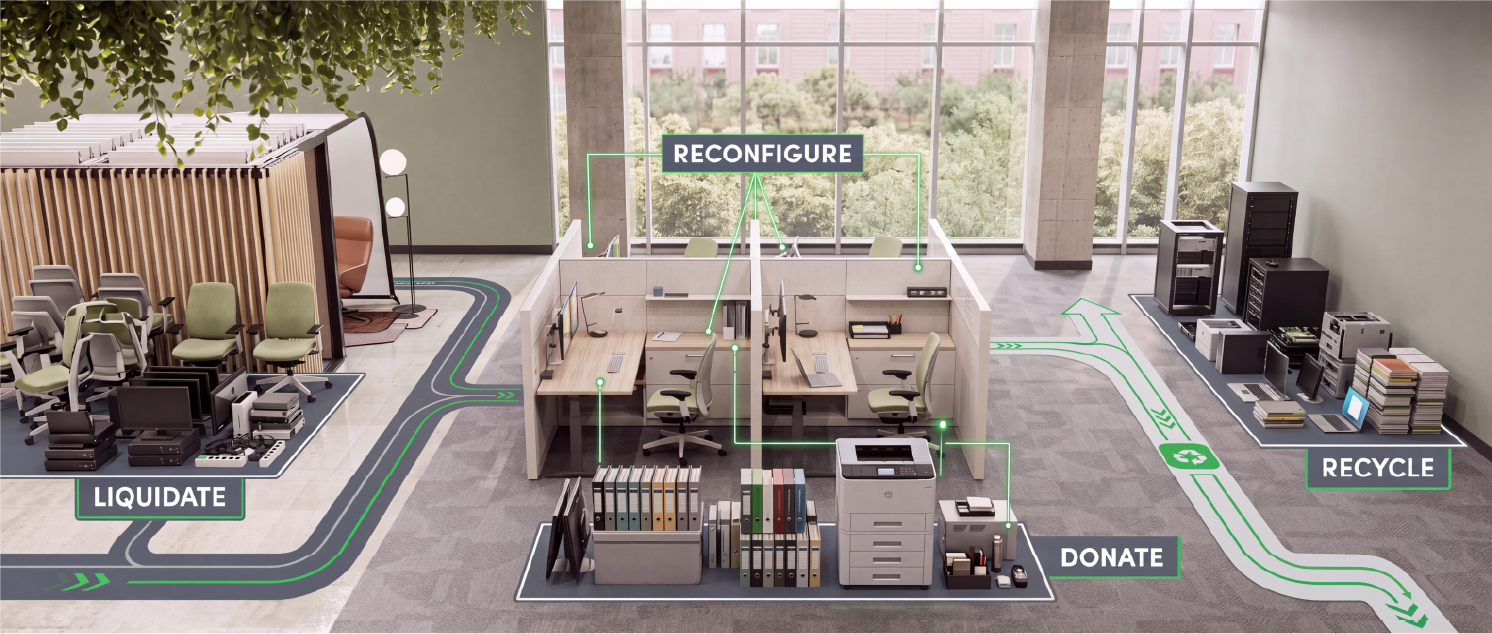
d’ploy manages the full end-of-life process for furniture and equipment, so clients get one accountable partner instead of a patchwork of haulers, brokers, and donation contacts. The process starts with a full inventory and a clear recommendation, then moves into disposition across four paths:
- Reconfigure and repurpose assets that still have life left in a new layout or location.
- Liquidate and reinvest, recovering value from assets a client no longer needs.
- Donate and redistribute usable furniture to charitable organizations, schools, and community partners.
- Recycle responsibly whatever has no remaining resale or reuse value, keeping it out of the landfill.
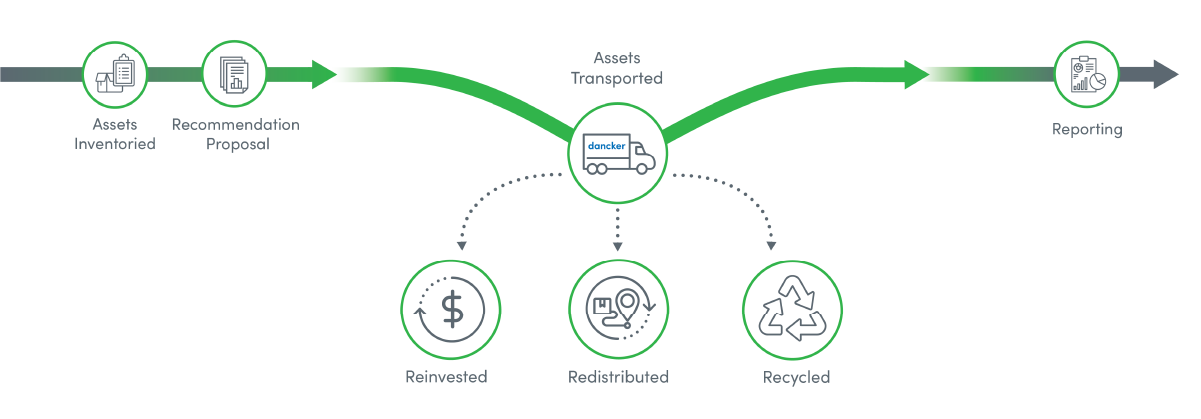
Every project closes with a report that shows exactly where each asset went, along with the environmental and financial impact of the decisions made along the way. That reporting is also where clients often find a marketing and public relations opportunity of their own: a documented, community-focused sustainability story tied to a project they already completed.
The Impact, By the Numbers
For reference, one metric is equivalent to the weight of a compact sedan. Since 2020, d’ploy’s sustainable decommissioning program has diverted 7,246 metric tons and 251,045 items from landfill on behalf of our clients. That includes:
- 5,441 metric tons and 215,966 items repurposed
- 689 metric tons and 20,148 items recycled
- 712 metric tons and 9,553 items reinvested
- 405 metric tons and 5,378 items donated to local charities
These aren’t projections. They’re the cumulative result of real projects, tracked and reported the same way we track every client engagement.
What This Looks Like in Practice
|
Workplace Client | Multiple Sites
d’ploy has managed sustainable decommissioning across multiple sites. In Tampa, Florida, the program diverted 331.18 metric tons and 7,661 pieces from landfill, while identifying between $1.1 million and $1.6 million in cost avoidance through reused, recycled, and resold assets. |
Technology Client | Newark, NJ
d’ploy managed more than 10 decommissioning and reuse projects, redeploying over $1.3 million in assets and achieving approximately $1.6 million in cost avoidance. The team relocated roughly 1,000 existing assets and diverted 22.44 metric tons of waste from landfill, using the client’s own space as a staging area to reduce storage and transportation costs along the way. |
Stevens Institute of Technology | Hoboken, NJ
For Stevens Institute of Technology, decommissioning became part of a bigger story. When students raised funds to renovate the Williams Library in Hoboken, New Jersey, they wanted the project to reflect the university’s commitment to environmentally responsible innovation. d’ploy ensured that everything not being reused was sustainably decommissioned, diverting 3.07 metric tons from landfill and donating 105 furniture pieces to Habitat for Humanity ReStore, a $3,130 fair market value gift-in-kind that gave the university’s old furniture a second life in the local community. |


A Growing Industry Conversation
d’ploy isn’t alone in thinking this way. HLW, an architecture and design firm, has published research on adaptive reuse and sustainable interior design, pointing to the same shift: designing spaces and specifying materials with disassembly, reuse, and repurposing in mind from the start, rather than treating end-of-life as an afterthought.
At the same time, furniture is increasingly showing up in corporate sustainability reporting. As frameworks like the EU’s Corporate Sustainability Reporting Directive expand what companies are expected to track, more organizations are being asked to account for the embodied carbon in what they buy and the waste created when they retire it. A documented decommissioning program isn’t just good practice anymore. For a growing number of clients, it’s becoming part of what they’re required to report.
Turning an Obligation Into an Outcome
However a space change gets started, whether it’s a lease ending, a consolidation, or a full renovation, what happens to the furniture left behind doesn’t have to be an afterthought. With the right plan and the right partner, it can become a documented, reportable win: for your budget, for the environment, and for your community.
Curious what sustainable decommissioning could look like for your next project? Connect with d’ploy to start the conversation.
Contact Us to Learn More on Our Logistical Solutions